



Kenya
Haiti's prime minister is in Kenya to discuss a controversial deployment plan as his country grapples with a security and political crisis.
The Caribbean nation has no elected representative.
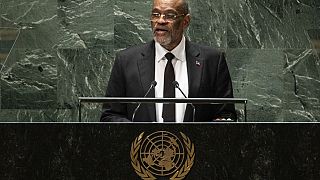
Giving a lecture Friday (Mar. 1st), Prime minister Ariel Henry reiterated his 2021 pledge to organize elections.
"Because of the violence, we cannot go to elections, and one of the things that we aim is to have elections as soon as possible because we need elections in order to stabilize the country," Henry said.
"We need a democratic governance in order to have people to come and invest in Haiti."
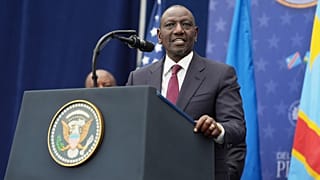
Kenyan's president announced on Friday (Mar. 1st) that both countries signed an agreement on the deployment of 1,000 Kenyan police officers.
Nairobi agreed in October to lead a U.N.-backed international force to Haiti, but in January, the Kenyan High Court ruled the plan unconstitutional.
The office of Haitian Prime Minister Ariel Henry said he was traveling at the invitation of Kenyan President William Ruto to "finalize modalities" for agreements between the countries on the deployment, which would send 1,000 Kenyan police officers to Haiti.
Kenya agreed in October to lead a U.N.-authorized international police force to Haiti, but the Kenyan High Court in January ruled the plan unconstitutional in part because of a lack of “reciprocal agreements” between the two countries.
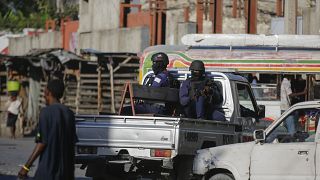
Gunmen shot at Haiti’s main international airport and other targets, including police stations, in a wave of violence that caught many people by surprise.




01:01
US judge blocks administration bid to end Haitians' protected status
01:19
United Nations renews political mission in Haiti for another year
00:47
Women and girls in Haiti facing 'explosion' of sexual violence, says MSF
01:11
Kenya starvation cult leader charged in connection with 52 further deaths
00:56
Road collision involving fuel tanker causes huge fire in Nairobi
01:25
Haiti's crisis deepens after transitional council votes to oust prime minister